

Summary
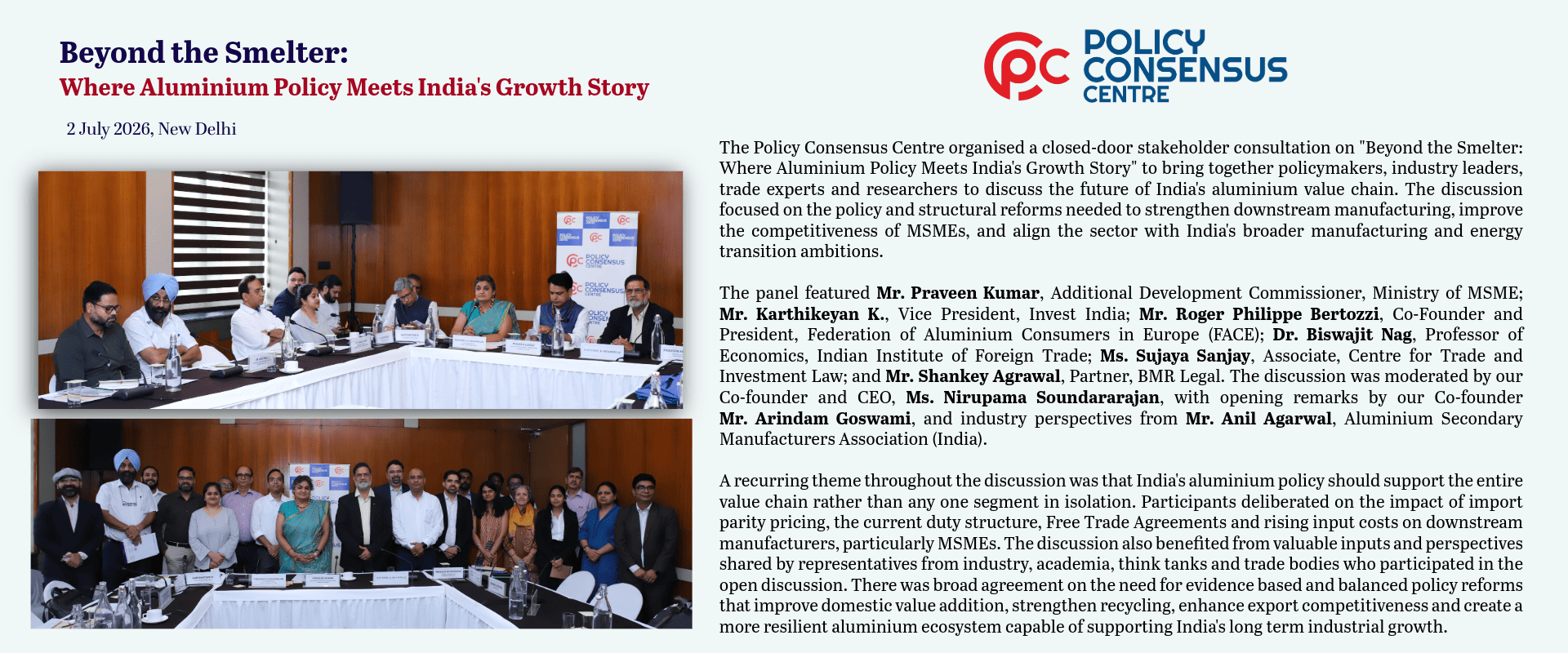
The Policy Consensus Centre organised a closed-door stakeholder consultation titled "Beyond the Smelter: Where Aluminium Policy Meets India's Growth Story" on 2 July 2026 in New Delhi. The discussion brought together policymakers, industry leaders, trade experts, researchers, and legal professionals to examine the future of India's aluminium value chain and the policy reforms required to support sustainable industrial growth.
The consultation focused on strengthening downstream manufacturing, improving MSME competitiveness, enhancing value addition, supporting recycling initiatives, and aligning aluminium sector policies with India's broader manufacturing and energy transition objectives.
Key Findings
- A holistic aluminium policy is needed to support the entire value chain rather than focusing on individual segments.
- Downstream manufacturers and MSMEs require greater policy support to improve competitiveness and encourage value-added production.
- Participants highlighted concerns around import parity pricing, existing duty structures, Free Trade Agreements (FTAs), and rising input costs affecting domestic industries.
- Increased emphasis on recycling and circular economy practices was identified as critical for building a sustainable aluminium ecosystem.
- Evidence-based and balanced policy reforms are necessary to enhance export competitiveness and attract further investment in the sector.
- Collaboration between government, industry, academia, think tanks, and trade bodies was recognised as essential for shaping effective aluminium sector policies.
- Stakeholders agreed that a resilient aluminium ecosystem will play an important role in supporting India's long-term industrial and economic growth ambitions.
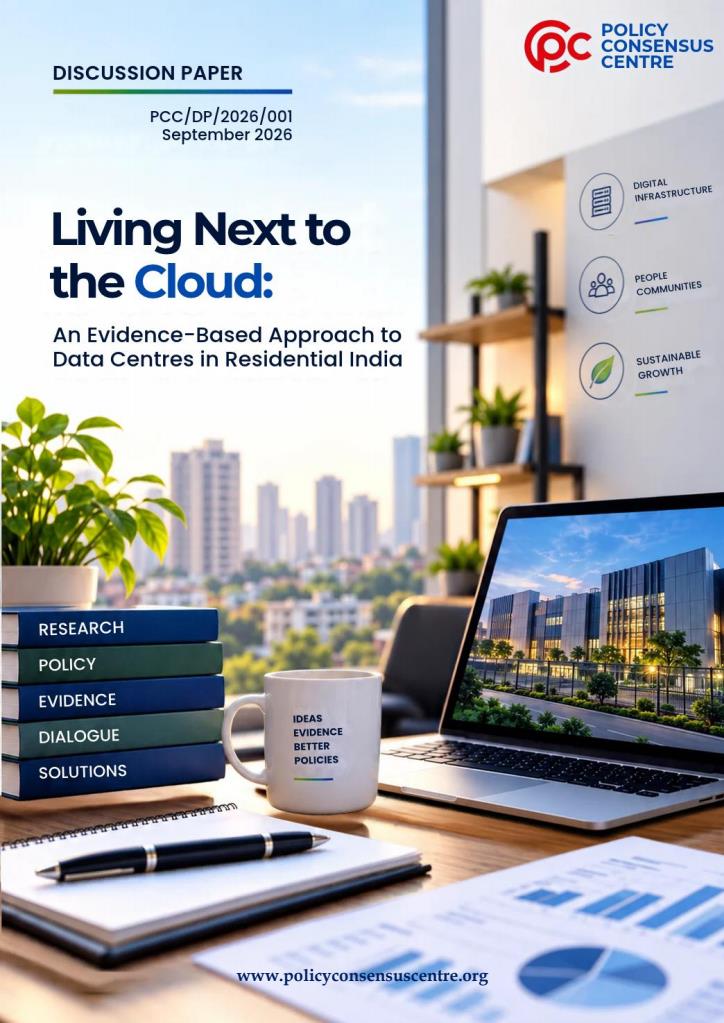
Policy Consensus Centre. (2026). Living Next to the Cloud: An Evidence-Based Approach to Data Centres in Residential India. New Delhi: Policy Consensus Centre. Available at: https://policyconsensuscentre.org
Policy Consensus Centre. (2026). Living Next to the Cloud: An Evidence-Based Approach to Data Centres in Residential India. New Delhi: Policy Consensus Centre. Available at: https://policyconsensuscentre.org
Frequently Asked Questions
What is a data centre?
A data centre is a facility that houses computing infrastructure, servers, networking equipment, and storage systems that support cloud services, websites, artificial intelligence, digital payments, government services, and business operations.
Why are data centres important for India?
Data centres support India's growing digital economy by enabling cloud computing, AI applications, 5G services, financial transactions, e-commerce platforms, and data localisation requirements.
Can data centres be located near residential areas?
Yes. Many countries permit data centres near residential areas, provided they comply with regulations related to noise, environmental impact, water use, energy supply, and safety standards.
Are data centres noisy?
Data centres generate noise from cooling systems, ventilation units, and backup power equipment. However, facilities must comply with applicable environmental noise regulations and use mitigation measures such as acoustic enclosures and sound barriers.
How much electricity do data centres consume?
Data centres require significant electricity to power computing equipment and cooling systems. However, the sector currently represents a relatively small share of India's total electricity consumption and is increasingly adopting renewable energy sources.
Do data centres use large amounts of water?
Water consumption depends on the cooling technology used. Modern facilities are increasingly adopting efficient cooling systems, wastewater reuse strategies, and alternative cooling technologies to reduce freshwater consumption.
What are the environmental concerns associated with data centres?
Key concerns include electricity consumption, cooling-related water use, backup power emissions, land utilisation, and noise. These impacts can be reduced through technological innovation, renewable energy adoption, and effective regulation.
What is Power Usage Effectiveness (PUE)?
PUE is a widely used metric that measures the energy efficiency of a data centre by comparing total facility power consumption with the power consumed by IT equipment. Lower PUE values indicate greater efficiency.
How can data centres become more sustainable?
Sustainability can be improved through renewable energy sourcing, efficient cooling systems, wastewater recycling, lower carbon emissions, battery storage solutions, and energy-efficient facility design.
What regulations apply to data centres in India?
Data centres must comply with environmental approvals, building regulations, fire safety requirements, pollution control norms, electricity regulations, and municipal development rules. Various state policies also provide sector-specific guidance and incentives.
What is the biggest sustainability challenge for data centres?
Water availability in water-stressed regions is considered one of the most significant local sustainability challenges, particularly for facilities that rely heavily on water-based cooling systems.
What policy reforms are recommended for India's data centre sector?
Recommended reforms include standardised reporting of resource usage, mandatory efficiency benchmarks, dedicated digital infrastructure zones, improved renewable energy integration, clearer residential setback norms, and greater use of treated wastewater for cooling applications.
Will artificial intelligence increase demand for data centres?
Yes. AI applications require significant computing power for model training, processing, storage, and real-time services, making data centres a critical component of future digital infrastructure.
Can data centres and residential communities coexist?
Evidence suggests that data centres and residential communities can coexist when supported by appropriate planning, environmental safeguards, infrastructure investments, transparency, and regulatory oversight.